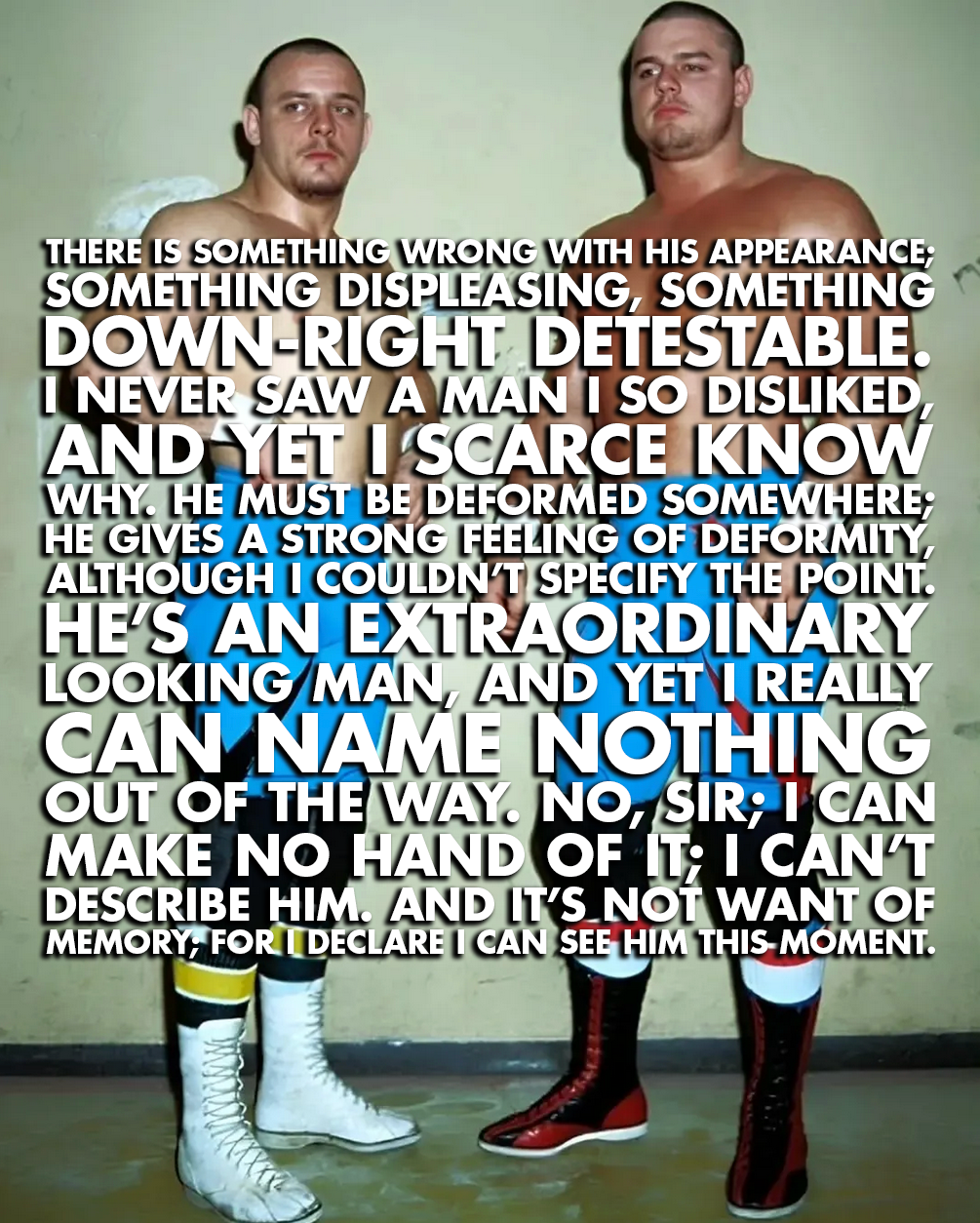
Under the Mat begins in media res with Davey Boy Smith, the British Bulldog, attacking Diana Hart, and jumps around in place and time to scenes of him fucked up on drugs, between vignettes of Diana Hart’s life and those of her relatives. It’s not until almost 100 pages in that he’s properly introduced to us, and we don’t immediately see whatever charm he had for Diana in the first place. We have to piece together the narrative of their courtship from these disjointed parts.
Chapter Fourteen is titled ‘Horrible Happenings.’ It begins thusly:
“When I was in grade ten I had my first crush and it was on the Dynamite Kid. He wrestled hurt. He wrestled with bad knees. Whether there was 15 or 15,000 people in the crowd, he wrestled his heart out every match. I had no interest in anybody my age because they didn’t measure up to Dynamite.”
You may already know what type of man Tom Billington turned out to be. When she meets his cousin Davey Boy Smith, she describes him as ‘[seeming] to have all the qualities Dynamite had. I decided he was the person I wanted to be with.’[1]
In his expansive study of Romantic hero archetypes The Byronic Hero, Peter Thorslev describes the Gothic Villain thusly:
“In appearance the Gothic Villain is always striking, and frequently handsome […] he has a tall, manly, stalwart physique, with dark hair and brows frequently set off by a pale and ascetic complexion.”
The appearance is important, he continues, because these villains are most often ‘pasteboard characters’ devoid of personality except their strength of will in their villainy, given the illusion of depth by some hinted-at secret sins or tragic past. But the most important aspect of these characters is their misogyny: ‘They take great delight in persecuting women […] since these are all novels of female sensibility.’[2]
Thorslev identifies the Gothic Villain as an antecedent of the Romantic hero; he traces over time how these characters become sentimentalized and sympathetic, their remorsefulness turning them from villains to complex anti-heroes.[3] Deborah Lutz describes this transformation as ‘the contractions of lover and enemy into one subjectivity’ that creates a new archetype of ‘the tragic hero whose main energy comes from villainous actions, self-destructive impulses, or character flaws.’[4] Atara Stein writes of the ‘irresistible and dangerous sex appeal’ of this ‘Byronic hero-villain,’ drawing on the example of Wuthering Heights’ Heathcliff to establish that ‘the idealized fantasy of a passionate and stormy love’ is exactly that — only a fantasy, incompatible with ‘human beings with financial, domestic, and other concerns’[5] of the real world.
Now, he’s not necessarily a sophisticated dandy in a haunted castle, but it’s hard not to see Davey Boy Smith’s reflection in some of these characteristics. As mentioned before, she saw the same passion and fire that Dynamite embodied in Davey in the ring, and it affected her quickly. ‘I had seen Davey’s photo in a Stampede Wrestling program and developed an instant crush on him,’ she says. But Davey is ‘remote’ and ‘distant’ in his manner, and she struggles to draw his feelings out from this aloof exterior.
The book elides their courtship almost in its entirety: Diana and Davey go on a date, then six months later they have sex in a car that breaks down and Davey has to push it uphill.[6] A few pages later, Davey is telling Diana another woman is pregnant with his baby on their wedding day.[7] In a certain regard, is this not an echo of Rochester’s bigamy revealed on the wedding day in Jane Eyre?
❦
To fill in the elisions, we have to turn to an unusual source. Diana Hart’s 2nd book, Cauliflower Heart: A Romantic Wrestler, the first book in a trilogy, came out in 2016. After putting the controvery of Under the Mat behind her she told the Calgary Herald that her next book, a romance novel, would be ‘reflective of me and my life but [not] necessarily things I have experienced.’[8]
Indeed, the book transposes the action far from the plains of Alberta to the other side of the Atlantic; Claudine Bonham is the daughter of Billy Bonham, an Olympic wrestler and the promoter of the Imperial Wrestling Federation. The family takes in Drew Bellamy, orphaned by the untimely deaths of his parents, to raise on their farm until he is old enough to inherit his father’s estate.[9] The situation is familiar to anyone with more than a passing interest in the tropes and vagaries of romantic fiction. It’s also not dissimilar from how TJ Wilson came to be in the Hart family, as Nattie Neidhart describes it in her memoir, The Last Hart Beating:
“[TJ] came from a broken home where he never met his dad, and his mom lived in women’s shelters […] He first came to the Hart House very malnourished because they didn’t have money for food. So Matt and Ted’s mom, Georgia, took TJ under her wing and pretty much let him live with their family.”[10]
He is, to put it in more Gothic terms, a foundling. Not entirely dissimilar to how the young Heathcliff comes to Wuthering Heights ‘starving, and houseless, and as good as dumb in the streets of Liverpool,’[11] though certainly, as a person, more pleasant and well-mannered.
The first time we see Drew Bellamy, he is described as having a ‘brooding expression,’ with dark eyelashes, dark curly hair, hazel eyes, high cheekbones and a square jaw that Claudine can already imagine on a wrestling magazine.[12] To compound on his tragic past, he is an adoptee whose biological parents are long gone as well:
“Me biological mum died when I was bein’ born,” said Drew. “When I was growin’ up, me adoptive mum, who was Tracy, well, she was actually me auntie, and she never said much about me biological dad, not much good about him, that is. Any [sic] my dad, Tommy, was actually me uncle, because he and me biological dad were brothers. […] After me biological dad was gone and the woman who gave birth to me died, me dad and mum raised me as their own son, not as their nephew, over in Chester. They put a headstone out back where we live, in the heather fields for me mum. […] Me mum and dad’s headstones are out there with hers now.”[13]
He takes to Claudine and the family quickly, pledging his loyalty to defend their honour even if the kids at school call their dad a fake or phony: ‘Your dad’s a saint and this country loves him. He’s done so much good for so many people […] If I hear anyone callin’ out this family in any way, I’ll bloody annihilate them!’[14]
The opportunity to annihilate comes quickly when Claudine’s class goes for swimming lessons. Though the Bellamy family is not quite as destitute as the Harts, Claudine has no swimming costume, so she goes to the pool in a t-shirt and her brother’s wrestling trunks. But when she gets out on the pool deck, she’s quickly shoved from behind into the pool. When she manages to climb out, it causes a scene as everyone begins to laugh at her. Headmaster Powell blows his whistle and shouts:
“This is a public swimmin’ baths, not the place for X-rated costumes or whatever you are piggin’ wearin’. See what you’ve started? I won’t tolerate indiscretions here! It’s piggin’ ridiculous! Have I made myself piggin’ clear? Go! Get out of the piggin’ public eye and get a proper piggin’ costume for swimmin’ or consider these swim lessons done! […] Piggin’ fool playin’ all innocent! I’ve no time for it!”[15]
It’s not until Claudine sees herself in the mirror in the dressing room that she realizes the cause of the outburst: ‘the water-soaked light blue T-shirt and sheer bra were now completely see-through. […] She may have well been topless.’[16] But soon another girl tells her that Drew had defended her honour:
“‘When Timothy Mellon said summat perverted about your bosom, that’s what really set Drew off […] I could tell that Drew had a dead tight hold on Timothy’s head,’ said Claire. ‘He wrenched on it good before he finally let go and I could see Timothy’s face turnin’ bright purple!’”
Claudine ‘felt something inside her come to life a bit when Claire told her about Drew’[17] and is ‘thrilled that Drew had been staring at her, and her alone’[18] when she got pulled out of the pool. After the incident, she wants to find a way to thank him, and decides to write him a letter. Unsure of how to express herself, she enscribes a romantic quote from none other than Winston Churchill:
“… my chief desire is to link myself to you week by week by bonds which shall ever become more intimate and profound. Beloved I kiss your memory — your sweetness and beauty have cast a glory upon my life. — Winston Churchill (1874-1965)”[19]
Their relationship quickly blossoms. They share their first kiss shortly after, then carry on with their romance in secret all through high school.[20] They resolve to stay chaste until Drew is old enough to marry, as he tells her, ‘from now ‘til me eighteenth birthday, we’ll just have to play it dead calm.’ They last a few months more, elope, then have sex for the first time. From that point, the narrative jumps ahead several years — now, they have two children and Drew is out on the road as a wrestler. The romance is over.[21]
In Under the Mat, Davey and Diana’s entire courtship makes up about ten pages where we learn almost nothing about him except that he’s handsome, somewhat naive, and emotionally distant. But when we look through the dewy-eyed, nostalgic frame of Cauliflower Heart, we can start to see an image take shape. If Under the Mat is a shapeless circumlocution around unnameable trauma, A Romantic Wrestler is trying to piece something back together in the vague shape of idyllic country life in Merrie England. It’s not grounded in any sense of historicity or realism or even emotional truth; it’s an aggregation of signs and symbols and memories roughly pasted together with the thin glue of sentimentality.
❦
“My person was hideous and my stature gigantic. What did this mean?”
— Mary Shelley, Frankenstein
There is another common archetype to Gothic literature I’d like to flag here, and that is the monster. Punter and Byron explain the role the monster plays in the Gothic thusly:
“What is primarily important […] is the cultural work done by monsters. Through difference, whether in appearance or behaviour, monsters function to define and construct the politics of the ‘normal.’ […] They police the boundaries of the human, pointing to those lines that must not be crossed.”[22]
Think of Doctor Faust, of Robert Louis Stevenson’s Dr. Jekyll and Mr. Hyde or Mary Wollstonecraft Shelley’s Frankenstein, where a monster is created through weird science to fulfill the need of its creator to exceed some personal limitation. In this case the monster Davey Boy Smith creates is himself.
Sharon Mazer noted that wrestlers become characters by “capitalizing on personal idiosyncrasies […] and developing them in relation to each other and an audience,” that is to say, taking your real self and turning it up to 11 as the well-worn cliche goes.[23] We sometimes call this ‘living the gimmick,’ to use another cliche. R. Tyson Smith, in his ethnographic study of indie wrestlers, further observes that “wrestling takes over performers’ daily routines and dictates most aspects of their everyday existence” with a “total focus that saturates the mind,” including the obsessive development of the physical body.[24]
As Diana puts it, “Davey was getting frustrated” because “he wanted to be bigger.” He is referred to a doctor who won’t give prescriptions but will provide the shots for cash-in-hand. Soon he receives “3 cc’s of Decadurbolin, the Cadillac of steroids,” and it doesn’t end there:
“Sometimes Dr. Dennis would hit him up with testosterone […] for gaining size and strength. But Davey became irritable and aggressive so the doctor gave him Percocet to take the edge off […] Soon Davey learned of a doctor in Hershey, Pennsylvania, John Zoharian [sic]. Dr. Zoharian would […] lock the door and offer up almost any drug known to man. While Davey was on the road, he would stop by and stock up: ten bottles of Deca-durbolin with syringes, 300 Halcion to sleep at night, 300 Valium and Placidyl […] a horse pill with 750 milligrams of tranquilizer. […] They’d put it in their mouths and wait for it to dissolve, then bite and chase it with a beer.”
The effects are immediate — Davey can soon bench-press 600 pounds, but he’s now on the treadmill of increasing drug dependency. In addition to the above, by the late 1980s Smith is taking speed daily[25] and by 1997 he has added “30 Percocet a day,” Xanax, Toradol, Vicodin, Talwin, Soma, Dilaudid,[26] morphine and cocaine.[27] Many will argue this is not at all uncommon for nineties wrestlers, though certainly by variety and volume Davey Boy Smith was somewhere atop the all-time leaderboard. It is here that I would like to point out the elixir that facilitates Dr. Jekyll’s transformation is a crystalline white powder.[28]
This is the process of transformation that creates the British Bulldog and makes him into a WWF Superstar. But creating a monster is a process that bifurcates the mind and soul into irreconcilable halves. As Masao Miyoshi writes of Dr. Jekyll and Mr. Hyde, “at once Jekyll’s Mephistopheles and his Frankenstein monster, [….] at the beginning [Hyde] is in fact merely Jekyll’s unrepressed spontaneous existence. […] Soon the Jeyll-Hyde metamorphosis becomes involuntary.” As Jekyll lives his gimmick more deeply, “his pleasure comes to depend on his torturing others.”[29]
A similar transformation happened to the Dynamite Kid. As Diana puts it, “Tom […] turned out to be a sadistic, masochistic bastard.” Because of his slight frame he had to abuse steroids heavily to achieve the physique he needed. He describes it in his own memoir, Pure Dynamite:
“Steroids became a way of life — not just for me, but for more or less all the wrestlers; the majority. […] Steroids didn’t just affect you physically, they affected your mind as well. At times I became so aggressive, somebody only had to look at me the wrong way for me to turn really nasty. I couldn’t control it.”[30]
His bodily transformation goes awry as well, as Diana describes him becoming “infested with boils” that he would slice “right off his arms with a razor.”[31] It starts to betray him in more subtle ways as well, causing “deterioration of […] tendons and ligaments and bones.”[32]
At first, however, the Faustian bargain they make does wonders and they become tag team headliners around the world, making $10,000 per week plus bonuses for the WWF, with $100,000 for three months’ work in Japan on the side.[33]
But the drugs were affecting Dynamite’s psyche and turning him into more of a ‘sadistic, masochistic bastard.’ His practical jokes were known for being particularly mean-spirited. When Davey first arrived in Canada, he was almost constantly sick and disorientated from his food being spiked by his cousin with laxatives and Valium.[34] This behaviour escalates — the maligned Paul Hogan knockoff wrestler Outback Jack is not only drugged by Dynamite, but stripped naked and urinated on with his bushman hat glued to his head.[35]
The pervasive hazing and ribbing creates an atmosphere of paranoia backstage. When ‘Mr. Perfect’ Curt Hennig chains the Rougeau Brothers’ bags to a pipe on the ceiling, the Bulldogs take the blame. Dynamite Kid, unable to control his temper at the accusation, sucker-punches Jacques Rougeau, shattering his jaw and ‘leaving him unable to wrestle for a month.’ The next time they meet face-to-face, Jacques blasts Dynamtie Kid with a roll of quarters and breaks his teeth.[36] ‘Those of us who really knew him realized that getting his teeth punched out was the beginning of the end for him,’ Bret later mused.[37] Not long after, the Bulldogs are out of the WWF. Returning to Stampede, they end up back on the dilapidated tour van doing the same old long road trips from when they started out. On the way to Prince George, driving through the Rockies in sleet and snow, the van hydroplanes and crashes and Davey is thrown through the windshield onto the road. He is knocked unconscious, but survives, and is left with 135 stitches in his forehead and herniated discs at the top of his spine.[38]
By this time, Davey Boy Smith is now coming into his own as a monster. Davey ‘turned the reign of terror up a notch’ by setting fire to a bed with a rookie wrestler still in it.[39] The horrific injuries only ramped up his drug use. Dynamite’s casual cruelty rubbed off on him to the point he thinks nothing of drugging his wife with GHB.[40] The last time we see Davey in Under the Mat, he’s arrested for threatening to slit Diana’s throat, and we hear that the judge lets him go on the condition he attends rehab and anger management.[41]
In May of 2002, Davey Boy Smith died of a heart attack at the age of 39. Bret Hart writes of attending his funeral: ‘I loved Davey like a brother. His biggest mistake was letting bad people influence his innocent heart.’[42]
At the end of A Romantic Wrestler, Drew Bellamy finally meets his estranged biological father Karl Beverly, who is described as ‘awful and sick’ with ‘a leathery face and bent, thin body […] covered in old, faded tattoos […] on his sagging skin. His face was pockmarked and rather puffy, and his head was bald and dull as a rock.’[43] If the description of a decaying, prematurely aged, toothless and crippled man doesn’t make it plain enough, a few pages later he is introducing the naive and innocent Drew Bellamy to powerful painkillers and surreptitiously dosing him with GHB.[44] In this strange, dream-like and Freudian inversion, Dynamite Kid has become the father of Davey Boy Smith, a father who becomes a filicide.
Drew travels to Germany and wrestles through grievous injury to get a payday for his family; Karl and his conniving nurse Hagra plot behind his back to get him addicted to morphine and steal his money. By the time Claudine arrives in Germany, Drew’s injury has become too much to bear and he is stricken with opiate withdrawals.
“[Claudine] still thought he was beautiful, even with his face cortorted with pain. She parted his dark hair away from his eyes. […]
‘I love you so much, and I’m sorry for… putting you through this,’ he gasped. ‘Don’t make it worse by watching me do it.’”[45]
Claudine leaves for the hospital; Hagra then injects him with morphine, and ‘just to be sure, she shot him up again, and again, and again.’ Then she double-crosses Karl and injects him with another dose in his ‘little emaciated deltoid,’ leaving the used syringe in his hand and making off with the stolen money.[46] In this fantasy Davey Boy Smith is recast as the tragic hero, the perfect victim. His big, innocent heart was just too trusting.
❦
Davey and Dynamite are not the only personages touched by the Gothic in Under the Mat. In fact, the entire family seems enmired in it, in one aspect or another.
Chapter seven begins with a memorable pronouncement: ‘Smith is quite warped, but he’s not a pervert.’[47] This chapter is where the book shifts into the mode it’s perhaps best known for — not quite a straightforward memoir of Diana Hart’s life, but a lurid record of scandal and score-settling. She begins by talking about Smith’s dissolute life and the children he has had out of wedlock with an ‘arena rat’ and a teenage prostitute. ‘Maybe Smith is crazy,’ Diana Hart concludes. ‘He didn’t used to be that way.’[48]
Diana then details Smith’s relationship with his wife Maria. He saw her on the beach in Puerto Rico and decided that he had to have her. He misrepresented himself as being the owner of Hart House to convince her to marry him. Once they arrive in Calgary, however, her behaviour becomes erratic and antisocial — smashing dishes and hanging naked from the balcony railing. Eventually things come to a head when Maria attacks Alison Hart unprovoked in the Hart House kitchen, ‘screaming like a wildcat, clawig and scratching’ and ‘tearing Alison’s hair out in clumps.’[49] The family gives Smith an ultimatum to take Tanya to the hospital to receive psychiatric care. He refuses, and they exile her back to Puerto Rico. Shortly afterwards, their daughter Tanya is born.
‘Tanya’s real name is Satanya after the devil. Satanya Ecstasy Hart. At the time Maria and Smith had lost their faith in God because of the way their lives had turned out,’[50] Diana explains. Madness, loss of faith and the invocation of the Devil are staples of the Gothic going back to the very beginning with Matthew Lewis’ 1796 novel The Monk in which Ambrosio, a corrupted monk, pledges his soul to Lucifer in order to be freed from certain death at the hands of the inquisition for his crimes. At first, though, Ambrosio believes his sins may yet be forgiven. ‘I will not doom myself to endless torments,’ he tells Lucifer. ‘Infinite is the Almighty’s mercy, and the penitent shall meet his forgiveness.’ Lucifer replies:
“Was purgatory meant for guilt like yours? Hope you, that your offences shall be bought off by prayers of superstitious dotards and droning monks? Ambrosio! Be wise. Mine you must be. You are doomed to flames, but may shun them for the present. Sign this parchment: I will bear you from hence, and you may pass your remaining years in bliss and liberty. Enjoy your existence. Indulge in every pleasure to which appetite may lead you. But from the moment that it quits your body, remember that your soul belongs to me, and that I will not be defrauded of my right.”[51]
To the monk who lived a dissolute life, Satan offers a bargain: God has abandoned him, but Satan offers him not only freedom, but the chance to live in Satanic ecstasy. For Smith Hart, warped, perhaps crazy, but not a pervert, he may have seen such an arrangement as something he could live with. Of course, as the father of all lies, the Devil has deceived Ambrosio and, in their flight, drops him to his death having claimed his soul.
Smith Hart passed away from terminal prostate cancer in 2017. In the Facebook post dated January 21, 2016 where he announces his diagnosis he writes: ‘Given the diagnosis I will be spending my upcoming time focused on finishing and hopefully releasing my autobiography.’[52] The autobiography remains unreleased as of this writing.
Chapter thirteen is titled ‘Shaved Ice’ and deals with Dean Hart’s death. The name comes from the only thing he was capable of drinking as he died of kidney failure, as Diana explains: ‘he couldn’t drink anything, even water, because his kidneys couldn’t flush it out.’ He eats his shaved ice while sitting in front of the commercial oven in the Hart House kitchen cranked to 500 degrees, ‘freezing and thirsty.’ It’s here that Diana makes a remarkable confession:
“He must have wondered […] why none of us ever gave him a kidney. There were 13 potential donors including my parents, not even coutning the nieces and nephews or his own kids. None of us was even tested. I still can’t explain why nobody gave Dean the kidney he needed.”
It’s a remarkable moment of self-awareness in a book mostly devoid of it. ‘We were so caught up in our own worlds we didn’t recognize that Dean had a limited amount of time,’[53] she concludes.
Finally, chapter twenty-nine is simply titled ‘Matt.’ It is three pages in length but is where the Gothic themes of Under the Mat reach their inflection point. Georgia and B.J.’s son Matt is taken ill. After being head-butted in the groin play-wrestling with his cousins, he is beset by odd symptoms. Within a few days, Diana says, he had ‘turned the color of an eggplant and was having trouble breathing. […] The family was told Matt was the sickest boy in the whole country.’[54]
As the week goes on, his condition worsens. ‘Everything was shutting down except his heart and his brain. His fingers had shrivelled up into long, skinny raisins. His whole body was cold and hard.’[55] The family rushes to his side as he is soon diagnosed with flesh-eating disease. According to Diana, a friend of the family gets in touch with Mother Teresa, who prays for Matt. The doctors believe that they can ‘save Matt by cutting off his legs with a saw and it would have to be quick’ because otherwise the flesh-eating disease could spread to his heart.[56]
Thirteen days after he is admitted to the hospital, it becomes clear there is no saving Matt:
“He was drowning in his own blood. One of the doctors joined us and with tears in his eyes, he told us they couldn’t save Matt. He said we had perhaps two minutes to say goodbye. […] I stroked his atrophied foot. It was cold as ice. […] Georgia wept, “There is no heaven. God would never let this happen to you, Matt.” […] As Matt’s heart beat for the last time, blood poured out of his mouth like a waterfall. When the blood ceased, Matt was gone.”[57]
The other Hart family memoirs all talk about Matt’s illness and broadly corroborate the details — Bret specifically names the disease as ‘a barely pronounceable infection, necrotizing fasciitis’[58] But only Diana’s account is so pitched with emotion and so thorough in the specific grotesquerie of his condition. It is the only account that mentions blood pouring out of the boy’s mouth ‘like a waterfall.’ How much of this is dramatic license, literary invention or overheated imagination intruding on memory?
This particular episode has stayed in my mind for years since I first read Under the Mat. Even now, after reading thoroughly on the subject and writing thousands of words on it, I struggle to make sense of it. In a book that shifts gears so suddenly, where Diana is being suplexed on the lawn by her out-of-control crackhead husband on one page and then reminiscing about Andre the next, it’s difficult to really get a grip on the text. This brief three-page episode is so forceful in its imagery that it somehow stands apart from anything else in the book.
On the following page, Diana again abruptly shifts gears to talk about her appearance on the Canadian Stampede pay-per-view. One thing that becomes clear when you read Under the Mat is that it is, in part, an account of Diana Hart’s own stardom, and her unrelenting self-belief in it. That story, however, gets sidetracked by the recriminations and scandal-making that make up the bulk of the text.
Earlier in my introduction I said that Diana Hart may well have been the Gothic heroine fleeing the dilapidated house up on a wind-swept moor over Calgary, but I think it might be just as fitting to compare her to Nelly Dean, the chattering housekeeper from Wuthering Heights, albeit a Nelly Dean who nevertheless believes she is the main character of a story that has a half-dozen Heathcliffs.
❦
‘Suicide […] is the most Gothic of acts,’ write Andrew Smith and William Hughes in the introduction to their volume Suicide and the Gothic. They continue:
“Suicide is, essentially, a momentary event with profound and lasting implications, a physical singularity that generates multiple social consequences, a point of crisis for the self and for those who perceive that self. […] The implications of suicide may function even where the act is deferred or never actually completed.”[59]
The opening anecdote of Under the Mat: Diana Hart recounts typing a suicide note on her home computer. ‘Davey’s a junkie. He doesn’t even try to hide it anymore. My family won’t listen when I tell them,’ she writes. She walks in on him snoring in bed and wakes him by screaming, ‘Look what you’ve done, you bastard. […] I’m going to take your goddamn pills so you know what I put up with night and day. […] Call 911 if I mean anything to you, Davey,’ before downing an entire bottle of Xanax.
‘The impact of what I had just done hit me,’ she recalls. Seeing a borderline-catatonic Davey Boy struggling to sit up ‘like a turtle on its back,’ she realizes whatever gesture she intended has been lost on its’ audience and calls 911: ‘Send an ambulance immediately. I just took 100 Xanax. I had a fight with my husband. I don’t want to die. […] I don’t want to die. I don’t want to die.’ Then, in a moment of lucid practicality, she gets dressed in sweatpants, a loose t-shirt and clogs because ‘it would be easier for the emergency room.’[60]
Kirstie McLellan’s later co-authored work, Theoren Fleury’s autobiography Playing With Fire, also begins with a suicide attempt. The scene is set:
“I stopped at the first pawnshop I came to, pulled out everything I had in my pockets and slapped it on the counter. About five grand in cash. The owner handed me a gun and one bullet. I drove home, laid the gun and the bullet on the glass coffee table in front of the couch. Then I grabbed one of about ten bottles of lemon Stoli from the freezer and sat there swigging. […] At 2 a.m., I reached over, picked up the gun, loaded it, flipped the safety off and put the barrel in my mouth with my finger shaky on the trigger. […] It tasted lonely. Cold, lonely and black.”[61]
Why is it that the misery memoir genre has come to use suicide as a hook to engage the reader? As Hughes and Smith write, suicide is ‘a provocative and culturally rich event.’[62] On the other side, Sue Vice states that the misery memoir’s goal is, above all, to ‘engage the reader, and to do so by means of an assertion of authenticity.’[63] Both Fleury and Diana Hart’s memoir begin with just such a hook: a moment of soul-baring confession, exopsing the author’s desperation at their lowest point. They both conform to the mis-lit formula, shaped by their shared co-author. Same genre, same goal: one book succeeded and sold hundreds of thousands of copies and the other was withdrawn from circulation.
Anne Rothe likens the overwhelming commercial success of the misery memoir to the craze over the Gothic romance hundreds of years earlier: it’s a spectacle of ‘voyeuristic titillation’ to witness the suffering of another. The only difference between then and now is a desire to not only witness pain and suffering but to be assured ‘that it really happened.’ She makes a tentative explanation drawing on empirical research of audience response to violence in media:
“Displays of violence in television programs […] and popular literature genres like misery memoirs are widely consumed neither because of their supposed aesthetic appeal nor because they enable audiences to engage in vicarious identification and/or cathartically purge negative arousal states. In fact, the appeal is not primarily the represented violence itself, but rather the melodramatic plot structure and particularly the redemptive-happy ending, which ensures consumer that, despite all apparent evidence to the contrary, the good forces will always triumph over evil ones and we thus live in a just world.”[64]
Misery memoir, Gothic romance, professional wrestling. What’s the difference? We’re all just waiting for the babyface to go over.
❦
In Marita Nadal’s reading of ‘The Fall of the House of Usher,’ she suggests that Poe is trying to say something about trauma at a time when it is still unidentified and poorly understood — it conveys a desire to emerge from a totalizing event that locks us in patterns of repetition.
“However, the search for origins results in failure, since in these tales memory is not only unstable and tricky but also self-erasing, like the fragmented identity of their protagonists. Their excavations do not provide a new historical security, but only an ‘overhang’ graphically represented by the return of […] Madeline from the tomb: they are made visible, but their uncanny apparition fails to unveil the core of the trauma that they catachrestically personify.”[65]
In a similar way, Under the Mat’s disjointed narrative structure and desperate, searching qualities reflect Diana Hart’s attempt to make sense of what has happened to her both within and without the fallen House of Hart. She talks herself in circles throughout Under the Mat and even Cauliflower Hearts because it seems she doesn’t know what it it she is really looking for or trying to say. Her circumlocutions and ellipses trace the outline of something that can’t be expressed. This is the uncanny. The very stuff of the Gothic. How do we escape this Dungeon?
On May 9th, 2026, promoter Brett Lauderdale took to X (formerly Twitter) to write some reflections on Teddy Hart. ‘Easily one of the most naturally gifted and talented individuals to ever step in a ring […] He was also tragically complicated.’[66] Teddy was unwittingly miscast in the role of a Byronic hero (mad, bad and dangerous to know), as the replies filled with fans calling him one of the great ‘what if’ cases in professional wrestling. Of the third generation Hart wrestlers, Teddy was the one singled out as the star of the future, signed to a WWF contract at the age of 18. It didn’t happen for him.
His cousin, Nattie Neidhart, was more of a long-shot, coming of age at a time when women’s wrestling wasn’t wanted or taken very seriously. At the very end of her recent memoir, The Last Hart Beating, she writes of the pressures of coming from such a famous family with such ‘overdetermined trauma’:
“In a family that’s done it all, I can’t be the first Hart world champion, I can’t be the first Hart Hall of Famer, but I can be the first to overcome the odds, and be the first of us to leave this business we’ve all loved without being broke or broken.”[67]
It’s an odd thing to really think about, this juxtaposition of high and low, the idea that the Hart family is one of the most decorated, most lauded families in wrestling history, and yet they are also characterized primarily by death and failure. The mercurial nature of the wrestling business comes as no shock or surprise, but that one generation after another would sequentially walk into the wood-chipper knowing exactly what would happen…?
Cathy Caruth writes that a ‘trauma repeats itself, exactly and unremittingly, through the unknowing acts of the survivor against his very will.’[68] When we look at the third generation of the Hart Family, what can we say? Harry Smith is out chasing UFOs, Ted Annis (dba Teddy Hart) is possibly a murderer. Nattie Neidhart seems to be the one wrestler of her generation to have achieved some degree of integration and healing.
How do we make sense of it? The closest thing to actionable advice in any of the literature I’ve read for this project comes from Martha Hart’s book: ‘In order to go on in a healthy direction and to really start living again, I needed to let everything go.’ She describes, after settling her landmark lawsuit with the WWF over the wrongful death of her husband, writing a letter to Vince McMahon. ‘I wanted him to think about how he lived his life, and that what really mattered was whether you were a good person or not.’[69]
Diana Hart sat down to write Under the Mat and thought about how she had lived her life. She cast herself as the tragic maiden fleeing the Gothic castle. I can’t say if she is a good person or not. I think she’s been unfairly maligned for what she wrote in Under the Mat and I’ve tried my best to do justice to the book here. But I think it’s pretty clear that she never escaped the Gothic castle.
Time heals all wounds. Diana Hart is now the public advocate and defender of the legacy of Davey Boy Smith, the man who beat and assaulted her. ‘Back then I was so uptight about things,’ she says in an appearance on the Wrestling Life podcast. ‘Jim Neidhart was in Davey’s corner, trying to get him better.’[70] Her hand enters the camera’s frame as she fixes her hair and she’s wearing Davey’s Hall of Fame ring.
Monsters and haunted houses aren’t real and they don’t emerge from nothing. We make them.
[1] Diana Hart. Under the mat. 77.
[2] Peter L. Thorslev. The Byronic hero: types and prototypes. (University of Minnesota Press, 1962), 53-55.
[3] Thorslev. The Byronic hero. 57-58.
[4] Deborah Lutz. The dangerous lover: Gothic villains, Byronism and the nineteenth-century seduction narrative. (Ohio State University Press, 2006), 29-30.
[5] Atara Stein. The Byronic hero in film, fiction and television. (Southern Illinois University Press, 2004), 25.
[6] Diana Hart. Under the mat. 101-103.
[7] Diana Hart. Under the mat. 107.
[8] Eric Volmers. “Diana Hart, youngest daughter of Calgary's iconic wrestling clan, finds romance in the ring with Cauliflower Heart trilogy.” Calgary Herald, December 19, 2015.
[9] Diana Hart. Cauliflower heart: a romantic wrestler. (Publisher Page, 2016), 3-6.
[10] Nattie Neidhart and Paul O’Brien. The last Hart beating: From the dungeon to WWE. (Simon & Schuster, 2025), 49.
[11] Emily Brontë. Wuthering Heights. (Norton, 1990), 29.
[12] Diana Hart. A romantic wrestler. 8.
[13] Diana Hart. A romantic wrestler. 32.
[14] Diana Hart. A romantic wrestler. 11.
[15] Diana Hart. A romantic wrestler. 25-27.
[16] Diana Hart. A romantic wrestler. 28.
[17] Diana Hart. A romantic wrestler. 29-30.
[18] Diana Hart. A romantic wrestler. 36.
[19] Diana Hart. A romantic wrestler. 38.
[20] Diana Hart. A romantic wrestler. 44-47.
[21] Diana Hart. A romantic wrestler. 62-68.
[22] Punter and Byron. The Gothic. 263.
[23] Sharon Mazer. Professional Wrestling: Sport and spectacle. (University Press of Mississippi, 1998), 89.
[24] R. Tyson Smith. Fighting for recognition: Identity, masculinity and the act of violence in professional wrestling. (Duke University Press, 2014), 42-43.
[25] Diana Hart. Under the mat. 121-122.
[26] Diana Hart. Under the mat. 2.
[27] Diana Hart. Under the mat. 176-177.
[28] Robert Louis Stevenson. The essential Dr. Jekyll & Mr. Hyde. (Plume, 1995), 108.
[29] Masao Miyoshi. “The Divided Self.” In The definitive Dr. Jekyll and Mr. Hyde companion, ed. Harry M. Geduld. (Garland, 1983), 104.
[30] Tom Bilington. Pure dynamite: The price you pay for wrestling stardom. (Winding Stair Press, 2001), 101.
[31] Diana Hart. Under the mat. 77.
[32] Billington. Pure dynamite. 100.
[33] Stephen Bell. Dynamite & Davey: the explosive lives of the British Bulldogs. (Pitch Publishing, 2022), 135.
[34] Diana Hart. Under the mat. 101.
[35] Bell. Dynamite & Davey. 170.
[36] Diana Hart. Under the mat. 124.
[37] Bret Hart. Hitman. 230.
[38] Diana Hart. Under the mat. 126-127.
[39] Bell. Dynamite and Davey. 191.
[40] Diana Hart. Under the mat. 140.
[41] Diana Hart. Under the mat. 198.
[42] Bret Hart. Hitman. 534.
[43] Diana Hart. A romantic wrestler. 131.
[44] Diana Hart. A romantic wrestler. 138-141.
[45] Diana Hart. A romantic wrestler. 162.
[46] Diana Hart. A romantic wrestler. 164.
[47] Diana Hart. Under the mat. 30.
[48] Diana Hart. Under the mat. 31-32.
[49] Diana Hart. Under the mat. 32-33.
[50] Diana Hart. Under the mat. 35.
[51] Matthew G. Lewis. The Monk. (Grove Press, 1952.) 413.
[52] Smith Hart (smith.hart.5), “2016 has begun in somber fashion,” Facebook, Januray 21, 2016. https://www.facebook.com/smith.hart.5/posts/pfbid02xRwYV97i3abRPJKkTT7PvAEbhYSGR7USWdmx1zFzSUhBVvr6vzYMYpLc1EaTkz7Al
[53] Diana Hart. Under the mat. 72.
[54] Diana Hart. Under the mat. 160.
[55] Diana Hart. Under the mat. 160-161.
[56] Diana Hart. Under the mat. 161.
[57] Diana Hart. Under the mat. 162.
[58] Bret Hart. Hitman. 395.
[59] William Hughes and Andrew Smith, “Introduction: the most Gothic of acts - suicide in generic context,” in Suicide and the Gothic, ed. William Hughes and Andrew Smith (Manchester University Press, 2019), 2-3.
[60] Diana Hart. Under the mat. 5.
[61] Theoren Fleury and Kirstie McLellan Day. Playing with fire: the highest highs and lowest lows of Theo Fleury. (HarperCollins, 2010), 2.
[62] Hughes and Smith. “Introduction.” 3.
[63] Sue Vice. Textual deceptions: false memoir sand literary hoaxes in the contemporary era. (Edinburgh University Press, 2014), 12.
[64] Anne Rothe. Popular trauma culture: selling the pain of others in the mass media. (Rutgers University Press, 2011), 94-98.
[65] Marita Nadal. “Trauma and the Uncanny in Edgar Allen Poe’s ‘Ligeia’ and ‘The Fall of the House of Usher.” The Edgar Allen Poe Review 17, no. 2 (2016), 189.
[66] Brett Lauderdale. (@Lauderdale11), “Ive met alot of people in almost 20 years in the "biz", very few had an aura, one was zandig, another was teddy hart,” X, May 9, 2026, https://x.com/lauderdale11/status/2052982209426911413
[67] Neidhart. The last Hart beating. 257.
[68] Cathy Caruth. Unclaimed experience: trauma, narrative and history. (Johns Hopkins University Press, 1996.), 2.
[69] Martha Hart. Broken Harts. 241.
[70] Wrestling Life (@wrestlinglifeonline), “Diana Hart: ‘These Are The Facts’”, Instagram, April 25, 2026, https://www.instagram.com/p/DXjd88rDC3_/